
How CCS Works: Four Stages
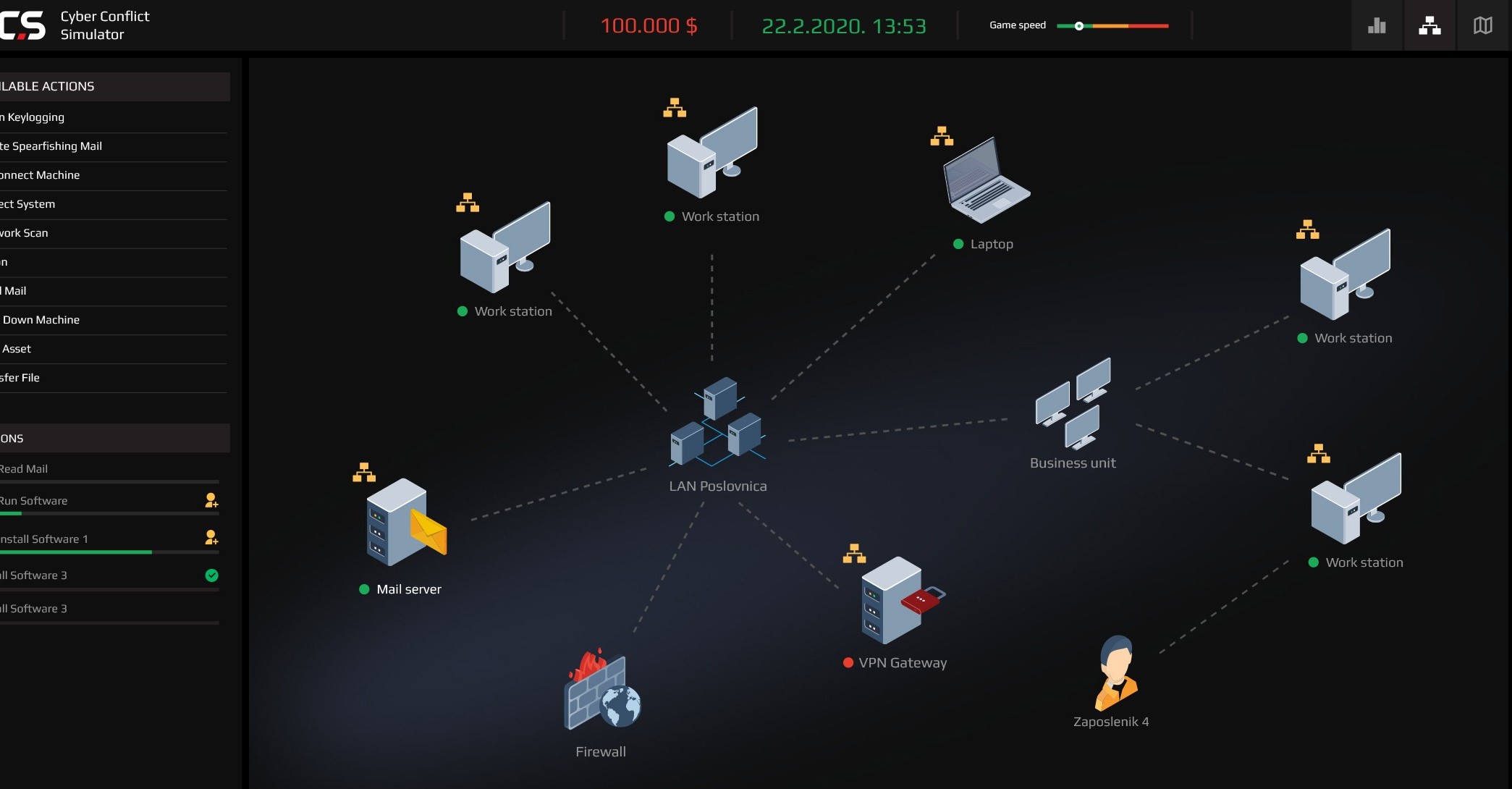
CCS creates a digital twin of your organization - IT/OT systems, security controls, business processes, and people - then runs realistic attack scenarios against it. Your teams respond. Every action, decision, and message is automatically recorded for structured after-action review.


Cyber Landscape Is Built
A digital twin of the organization is created - modelling the IT/OT infrastructure, security controls, business processes, people, and external dependencies. Business processes are linked to their IT/OT dependencies, so technical events can cascade into real operational consequences. Once built, the landscape becomes a reusable asset for unlimited future exercises.
- IT/OT infrastructure: servers, networks, SCADA, cloud services
- Security controls: firewalls, IDS/EDR, SIEM, access controls
- Business processes and their IT/OT dependencies
- People modelled with their skills, awareness levels, and habits
- Attackers from any threat source using intelligence-based TTPs
Attack Scenario Is Designed
The adversary's objectives, capabilities, and sequence of actions are defined through the landscape. Scenarios can be based on threat intelligence, the organization's risk profile, or specific regulatory requirements.
- Supports ransomware, APT, supply chain, insider threats, zero-days
- Flexible start point: early detection, mid-incident, or post-breach
- Attack steps recorded and replayable - no re-work for future exercises
- Multiple scenarios can be prepared from the same landscape
Simulation Is Run
Participants manage virtual team members by assigning tasks. Each actor performs based on defined skills and reports back - exactly as in reality. Time can be accelerated during waiting periods, compressing days or weeks into a few hours.
- Roles: Incident Manager, IT/OT, Legal, PR, Business, C-suite
- Built-in messaging system with simulation timestamps
- Time acceleration: compress days or weeks into hours
- Remote or on-site participation - no co-location required
After-Action Review
CCS records all relevant exercise data - actions, decisions, communications, and system events - in structured format. This gives trained personnel a solid, objective basis for a meaningful after-action review.
- Chronological mapping of incident and decision flow
- Evaluation of response timing and effectiveness
- Full communication log with simulation timestamps
- Foundation for IR procedure and playbook improvement


Built for the real complexity of
organizational incident response

Time Compression
A real-world incident spanning days or weeks is exercised in 1 day - maximum learning, minimal disruption.

Reusable Landscape
Create your cyber landscape once, run unlimited scenarios. A long-term asset, not a one-time exercise.

Business Impact Modelling
Model how IT/OT incidents cascade into financial loss, availability impact, and reputational damage.

Distributed Participation
Teams across departments, cities, or countries participate simultaneously. No need to be co-located.

IT/OT Support
Model both IT and OT/SCADA environments and their interdependencies, including physical-world consequences.

Integrated Messaging
All inter-team communication captured inside CCS with simulation timestamps for After-Action Review.

Extensibility
Expand CCS with new objects, actions, and controls through a plug-in mechanism. Evolves with your environment.

Compliance Data
Structured exercise data providing the documented basis needed to satisfy DORA and NIS2 auditors.

Red Team Flexibility
Pre-recorded sequences or active red team - or both. Match adversarial realism to your exercise goals.
Ready to see CCS in action?
Request a personalized demonstration.